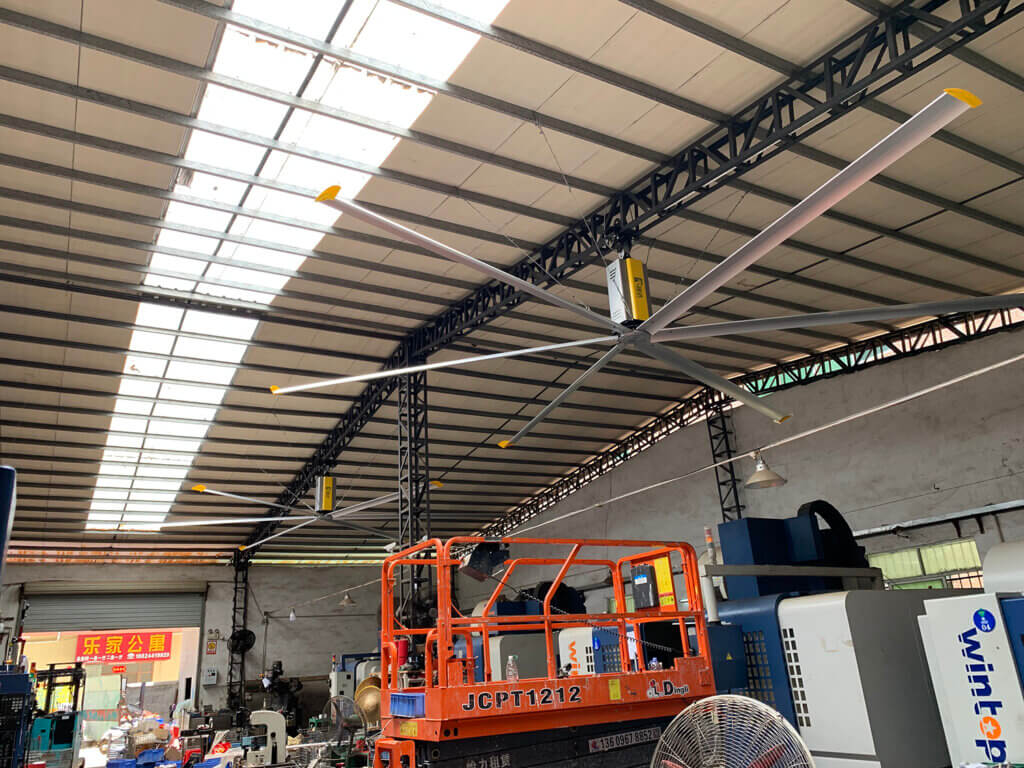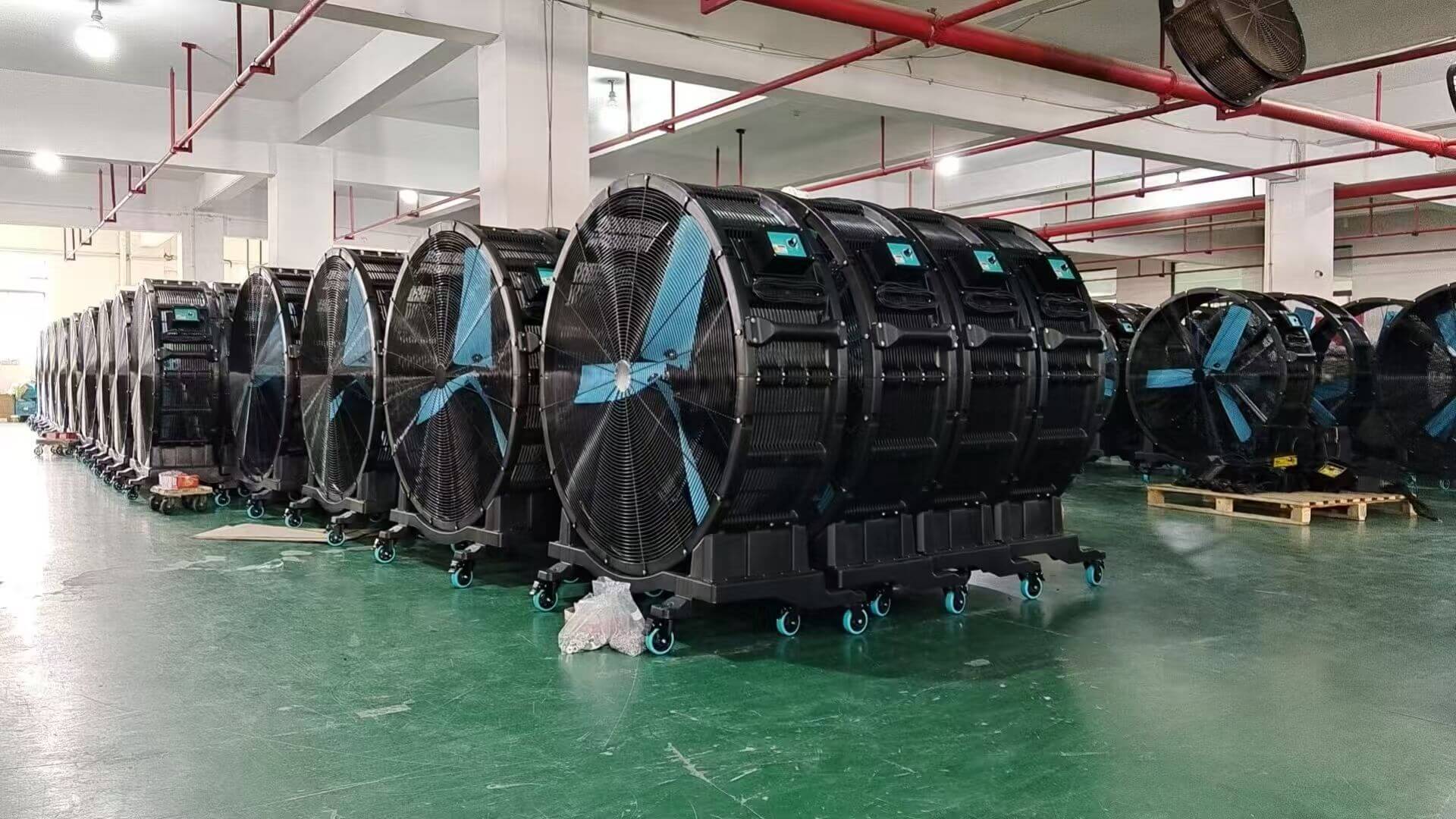
This wall-mounted fan size guide compares the 900 mm, 1200 mm, and 1500 mm models currently listed by Hengshuangda. Start with the zone that needs air movement, then compare the published airflow, rated power, noise, weight, mounting conditions, and available electrical supply. Diameter by itself is not enough to choose a model.
Compare the listed wall-mounted fan models
The product page lists these three configurations:
| Model | Diameter | Rated power | Maximum air volume | RPM | Noise | Blades | Weight |
|---|---|---|---|---|---|---|---|
| HSD-Q900 | 900 mm | 500 W | 16,800 m³/h | 700 | ≤70 dB | 5 | 80 kg |
| HSD-Q1200 | 1200 mm | 500 W | 25,200 m³/h | 450 | ≤65 dB | 5 | 92 kg |
| HSD-Q1500 | 1500 mm | 950 W | 43,200 m³/h | 400 | ≤65 dB | 6 | 105 kg |
These are the figures shown on the site’s product listing. Confirm the exact model, configuration, and test conditions with the supplier before using them for a project calculation. Maximum air volume is a catalog rating; the airflow at an installed location can be affected by the room layout, obstructions, and operating conditions.
1. Define the area that needs airflow
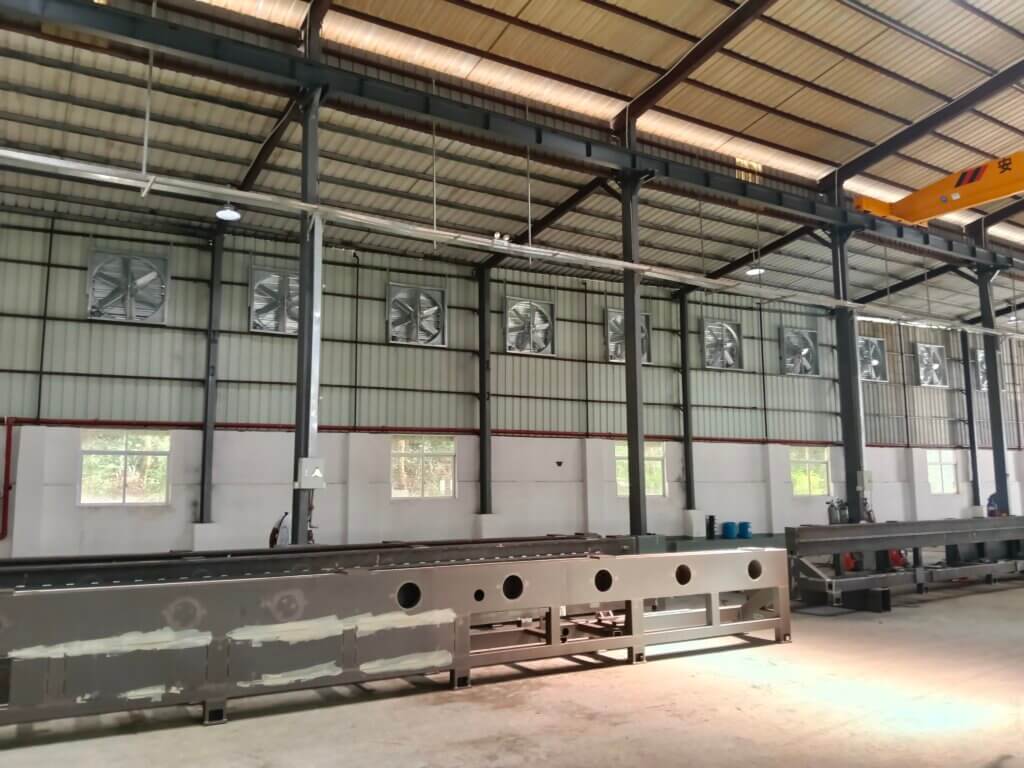
Mark the workstations or occupied zones where air movement is needed. Note the wall location, ceiling height, shelves, machinery, partitions, doors, and other obstructions. A wall-mounted fan can keep floor space clear, but its usefulness depends on whether its air path reaches the intended zone without being blocked immediately.
For a large or divided room, do not assume that one fan will serve the entire space. Ask the supplier or project designer to review the floor plan and the desired airflow path. The product page does not state a guaranteed coverage area for each model, so avoid choosing by an unsupported square-meter estimate.
2. Compare airflow and rated power together
Use the listed maximum air volume to compare the three catalog models, and read rated power as a separate electrical input figure. For example, the 1500 mm model has the highest listed maximum air volume and a higher rated power than the two smaller models. That comparison does not establish actual airflow or electricity use in a particular room. If performance at a specific operating point matters, request the applicable manufacturer data and selection guidance.
Do not treat RPM, blade count, or diameter as a stand-alone performance score. The listed models differ in several specifications at once. Compare the complete configuration against the needs of the room rather than assuming that one feature alone determines the result.
3. Check noise, weight, and wall support
The listing provides a noise figure and weight for each model. Consider where people work, how close the fan will be to occupied areas, and whether the listed noise rating matches the conditions important to your project. The fan’s weight also matters for installation planning. Have a qualified installer confirm that the wall and mounting arrangement are suitable for the selected unit; the product listing does not replace a structural assessment.
4. Confirm electrical compatibility
The product page lists 110–415 V and 50–60 Hz for the models. Before ordering, confirm the exact supply requirements, wiring, control options, and applicable local electrical practices for the selected configuration. Do not rely on a broad voltage range alone to determine whether a unit is ready to connect at a particular site.
A practical selection checklist
- Identify the work zone and the direction air should move.
- Compare the exact model’s listed airflow, power, noise, dimensions, and weight.
- Check obstructions and confirm that the proposed mounting point keeps the air path clear.
- Ask for model-specific performance information if the project depends on a target airflow.
- Confirm the wall support and electrical connection with qualified project personnel.
Frequently asked questions
Is the 1500 mm model always the best choice?
No. It has the largest diameter and highest maximum air volume among the three listed models, but it is also heavier and has a higher rated power. The right option depends on the required airflow, site conditions, wall support, and electrical supply.
Does a higher RPM mean a fan moves more air?
Not necessarily. The listed models have different diameters, blade counts, and power ratings as well as different RPM values. Compare the published airflow and full model data instead of using RPM alone.
Where can I check the current model specifications?
Review the Hengshuangda wall-mounted fan product page and confirm the details for the exact configuration before purchase.