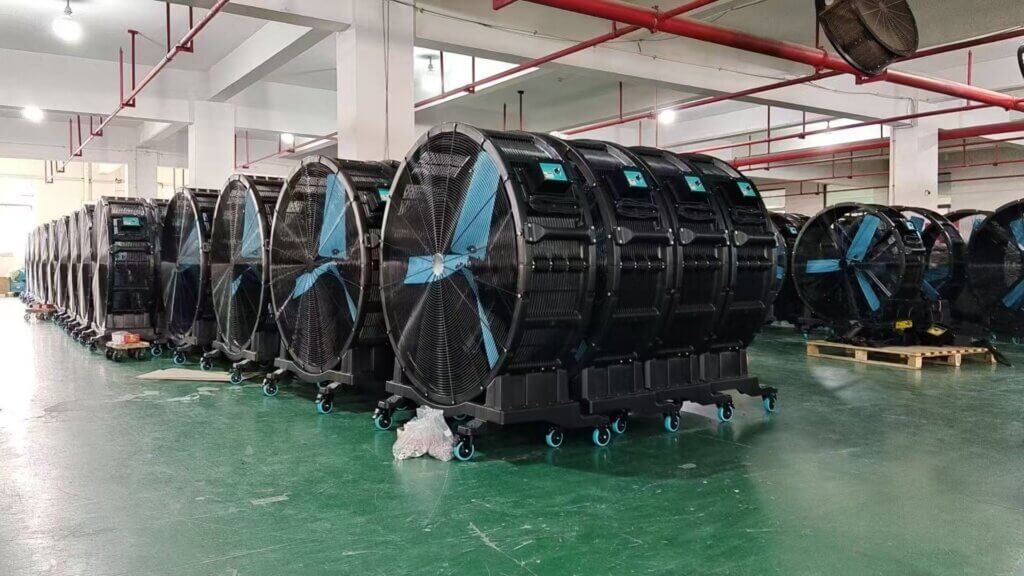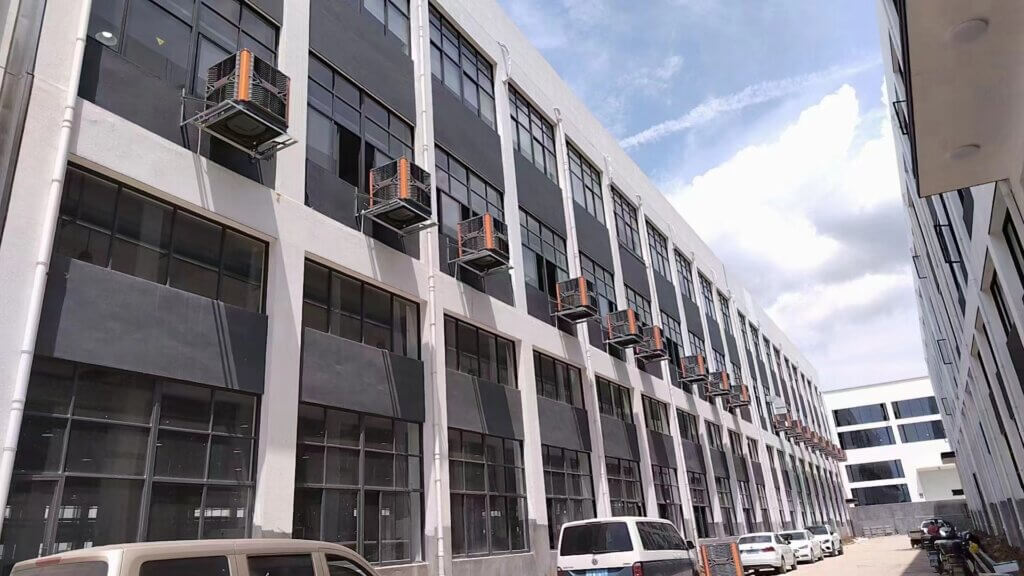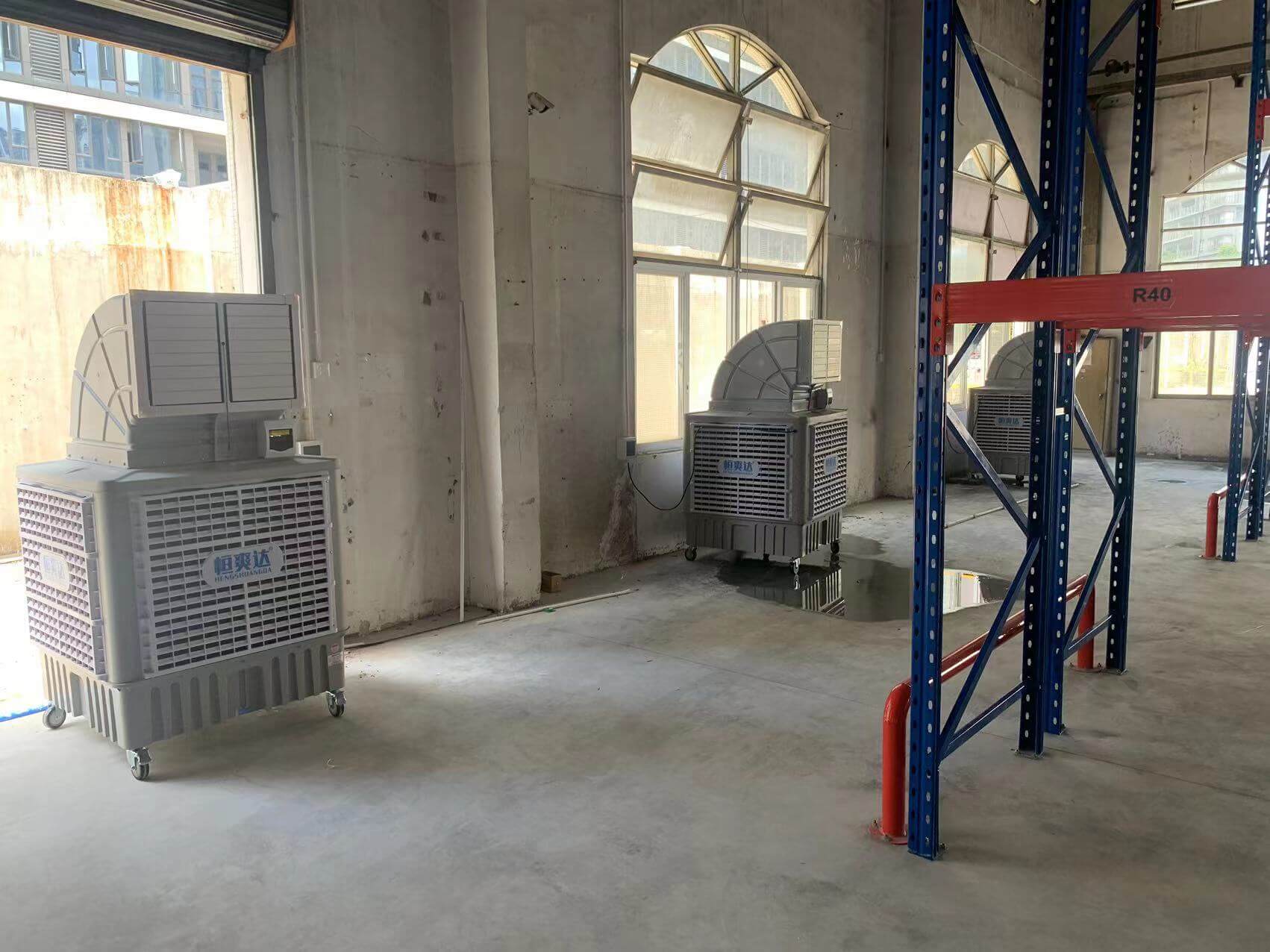
An industrial mobile evaporative air cooler can provide a movable source of cooled airflow for a defined work area. For a safe, useful setup, place the unit on a stable floor, keep its air intake and outlet clear, plan how air can leave the space, and confirm the model’s water and electrical requirements before operation. A mobile unit does not automatically cool every part of a large workshop.
How mobile evaporative cooling works
A direct evaporative cooler moves air across wet cooling media. Evaporation cools the supply air and adds moisture to it, so results depend on the surrounding air conditions. The method is generally more suitable in drier conditions. A mobile design changes where the airflow can be directed; it does not remove the moisture added to the air or turn the unit into a refrigerated air conditioner.
If a workshop has moisture-sensitive materials, a process that requires tight humidity control, or persistently humid conditions, assess suitability before relying on evaporative cooling. The site’s industrial evaporative air cooler selection guide explains the broader site conditions to review.
Choose a position for the work area
Identify the workstation, packing area, maintenance bay, or other occupied zone that needs airflow. Put the cooler on a firm, level surface where it will not obstruct aisles, exits, material handling, or equipment access. Keep the inlet away from walls, stored goods, and other obstructions, and direct the outlet toward the intended zone without disturbing loose materials or the work process.
When the unit is moved between stations, reassess its position each time. A fan outlet aimed at a workbench in one layout may blow paperwork, dust, or lightweight materials around in another. Check the airflow during normal work and adjust the direction or location if it causes a problem.
Plan the air path through the workshop
Evaporative cooling supplies air to a space, so consider where that air will go and how indoor air can leave. Openings or a planned relief-air arrangement help maintain a path through the occupied area. A closed room with no route for air to escape may not provide the circulation the setup requires.
Before selecting a regular operating position, note doors, windows, partitions, machines, and the locations of workers. Avoid placing the cooler so that its outlet is immediately blocked. In a divided workshop, review each section rather than assuming that a mobile unit will reach every work area from one position.
Confirm water, drainage, and electrical arrangements
Mobile models can differ in how they receive and manage water. Check the exact model instructions to see whether it uses an onboard reservoir or a water connection, what refilling or drainage tasks are required, and how to prevent leaks around the operating area. Do not assume that water arrangements are the same across models.
Check the nameplate and supplier documentation against the available electrical supply. Route the cable away from walkways, doorways, wet areas, sharp edges, and moving equipment. Keep the plug and connections dry and protected as directed by the manufacturer. Switch the unit off and follow its instructions before moving, filling, draining, or cleaning it.
Make relocation part of the daily routine
Before each use, check that the cooler stands securely, the intake and outlet are clear, the water arrangement is ready, and the cable will not create a trip hazard. After moving it, confirm the new location remains stable and the airflow does not disrupt nearby tasks. Stop operation if the unit leaks, becomes unstable, or develops unusual noise or vibration, and arrange an inspection according to the product instructions.
Follow the exact model’s maintenance directions for the water system and cooling media. Regular inspection can help identify leaks, deposits, blocked airflow, or other issues that affect operation. The site’s guide to the evaporative air cooler’s cooling principle provides additional background on the cooling method.
Frequently asked questions
Can one mobile cooler cool an entire workshop?
Not necessarily. Coverage depends on the specific model, workshop layout, obstructions, air path, and where the unit is positioned. Plan for the occupied zone and verify performance needs with the model information and supplier.
Does an evaporative cooler work like an air conditioner?
No. Direct evaporative cooling uses water evaporation and adds moisture to the supply air. It does not use a refrigeration cycle to dehumidify and cool the room.
Does the workshop need an air outlet?
A path for supplied air to move through and leave the space should be considered when planning an evaporative cooler setup. The appropriate opening or relief arrangement depends on the building and operating conditions.
Can I move the cooler while it is running?
Follow the exact model’s instructions. As a general precaution, switch off and disconnect the unit before moving it, then check the new position, water arrangement, and cable route before restarting.
Workshop setup checklist
- Choose a stable position near the occupied work zone.
- Keep the intake and outlet clear and plan a path for indoor air to leave.
- Check humidity and process conditions before relying on direct evaporative cooling.
- Confirm water, drainage, electrical, and maintenance requirements for the exact model.
- Recheck airflow, stability, and cable routing after every move.
A mobile evaporative cooler is easiest to use when each location is planned around the task, open airflow, and the unit’s model-specific requirements. Confirm those details before purchase and follow the product instructions during setup, operation, relocation, and care.