Quick answer: Choose a commercial stand fan by matching its air movement, electrical requirements, physical footprint, and placement to the space where it will operate. Start with the product data sheet, then confirm that the fan can be positioned safely without obstructing walkways, work areas, or other equipment.
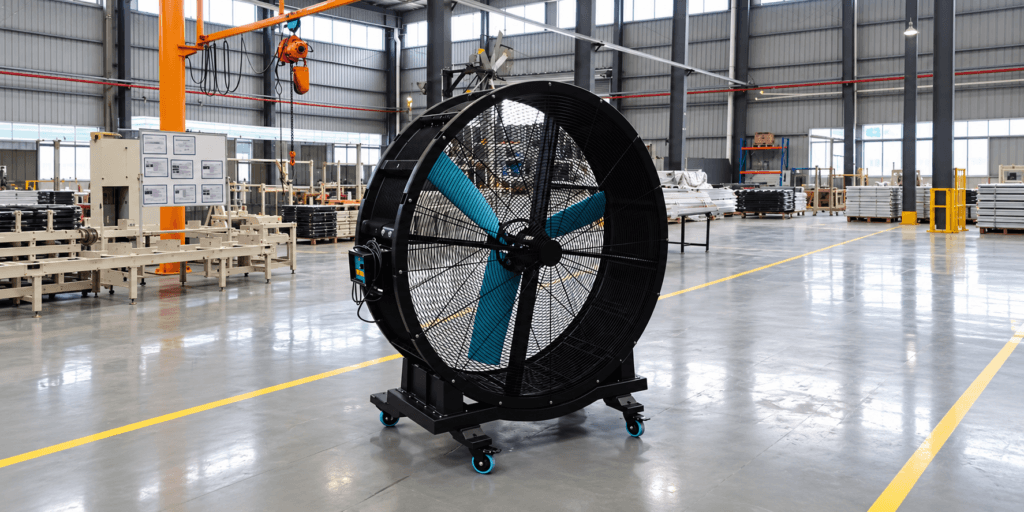
Hengshuangda’s Commercial Stand Fan is presented for spacious commercial settings and lists two models. The published product page provides rated power, voltage, maximum air volume, diameter, speed, noise, blade count, and weight. Use the exact model data and installation conditions when comparing options.
1. Define the area that needs air movement
Map the operating area before comparing fan models. Note the floor space, ceiling height, workstations, shelving, doors, vehicle routes, and locations where people spend time. A large open space may need air movement across a broad area, while a divided or obstructed layout can change where a stand fan is useful.
Also clarify the purpose. A fan circulates air; it does not by itself provide refrigeration or remove a contaminant at its source. If the project requires temperature control, smoke or dust extraction, or a defined ventilation rate, identify that requirement separately and have the full system assessed.
2. Compare the published model data
The product page lists these Commercial Stand Fan configurations:
| Model | Rated power | Rated voltage | Maximum air volume | Diameter | Speed | Noise listed | Blades | Weight |
|---|---|---|---|---|---|---|---|---|
| LSFS-S4280 | 1000 W | 220 V | 234,000 m³/h | 4,280 mm | 90 rpm | ≤40 dB | 6 | 245 kg |
| LSFS-S3680 | 750 W | 220 V | 204,000 m³/h | 3,680 mm | 95 rpm | ≤40 dB | 6 | 242 kg |
These figures are the values shown on the website product page. Confirm the current specification, measurement conditions, supply compatibility, and any project-specific options with the supplier before ordering. A maximum air-volume figure alone does not describe the air movement at every point in a real space.
3. Check footprint, placement, and access
A stand-mounted unit uses floor space. Check the base footprint, route for moving the equipment into position, nearby doors and equipment, and the area needed for inspection or service. Keep the fan clear of pedestrian and vehicle routes, and follow the manufacturer’s installation instructions for placement and operating clearances.
The product page describes a broad base and a low center of gravity. Still, suitability depends on the actual floor, location, and operating conditions. Ask for installation guidance for the intended site rather than assuming one placement fits every facility.
4. Verify electrical and operating requirements
Compare the rated voltage and power with the facility’s electrical supply and the expected operating schedule. Ask the supplier to confirm connection details, speed-control options, and any protection or control equipment included with the chosen configuration. Do not infer these details from a headline specification.
5. Plan safe day-to-day use
- Place the unit on a suitable, level surface and follow the installation instructions.
- Keep the fan and its power connection away from routes where they could be struck, tripped over, or exposed to water.
- Keep people, loose materials, and movable equipment clear of the fan’s operating area.
- Inspect and maintain the unit as directed by the manufacturer; stop operation if unusual movement, noise, or damage appears.
Commercial stand fan selection checklist
- What area needs air movement, and what is the main purpose?
- Which listed model matches the available floor space and required coverage?
- Does the electrical supply match the selected model’s stated requirements?
- Can the unit be placed without obstructing people, vehicles, or work processes?
- Have the current specifications, installation conditions, and service requirements been confirmed?
Frequently asked questions
What spaces are listed for the Commercial Stand Fan?
The product page lists commercial spaces, shopping malls, supermarkets and retail stores, exhibition centers, sports facilities, transportation hubs, docks, open-air markets, and construction sites. Confirm that the selected model and installation arrangement suit the specific environment.
Which models are shown on the product page?
The page lists LSFS-S4280 and LSFS-S3680, with different rated power, diameter, speed, maximum air-volume, and weight values. Refer to the current product page and confirm the specification before purchase.
Does a commercial stand fan cool a space like an air conditioner?
No. A fan moves air to support circulation; it does not provide refrigerated cooling. If the project needs temperature reduction or a specified air-quality outcome, assess that requirement separately.
Where can I review the product details?
See the Commercial Stand Fan product page for its listed applications, model data, components, and installation information.
Product specifications and applications are summarized from the Hengshuangda website’s Commercial Stand Fan page. Confirm the current details and site suitability with the supplier before making a selection.